





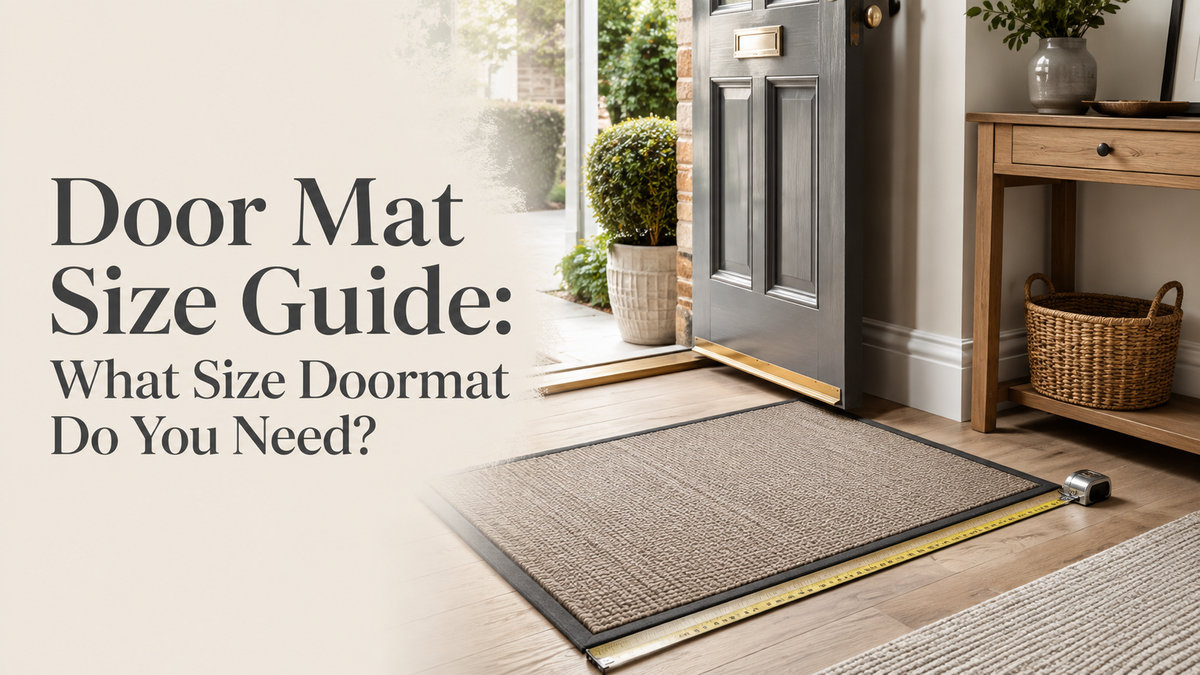
Choosing the right door mat size is easier when you start with the entrance rather than the mat. Measure the available floor space, check how the door opens, and make sure there is enough usable surface for people to step onto the mat comfortably.
No single doormat size fits every UK home. Compact entrances may suit a 40 × 60 cm mat, while many single-door areas can fit 50 × 80 cm or 60 × 90 cm. Larger entrances can take an 80 × 150 cm mat, while an 80 × 300 cm runner suits a long hallway or extended entrance.
Door Mat Sizes at a Glance
If you are not sure where to start, use this table as a practical guide.
|
Door Mat Size |
Approx. Size |
Can Suit |
|
40 × 60 cm |
1.3 × 2.0 ft |
Back doors, small porches and compact entrances |
|
50 × 80 cm |
1.6 × 2.6 ft |
Many single-door entrances |
|
60 × 90 cm |
2.0 × 3.0 ft |
Wider front doors and entrances with more floor space |
|
80 × 150 cm |
2.6 × 4.9 ft |
Large entrances, porches and wider floor areas |
|
80 × 300 cm |
2.6 × 9.8 ft |
Long hallways and runner-style entrance spaces |
These are useful starting points rather than fixed rules. Your measurements should always decide the final size.
What Is a Standard Door Mat Size in the UK?
There is no universal UK standard.
Different retailers use slightly different dimensions for their everyday doormats. Sizes around 40 × 60 cm, 45 × 75 cm, 50 × 80 cm and 60 × 90 cm are all commonly available.
Rather than looking for a mat labelled “standard”, measure your own entrance. A mat that works perfectly outside one front door may look too small or stop another door from opening properly.
For the RugsPile rubber entrance mat range, 40 × 60 cm is the most compact option, followed by 50 × 80 cm and 60 × 90 cm for entrances with more room.
How to Measure for a Door Mat
You only need a tape measure and a few simple checks.
1. Measure the Usable Entrance Width
Measure the floor area from side to side where the mat will sit. Do not rely only on the width of the door itself, especially if there are walls, steps, frames or furniture close to the entrance.
A mat does not have to match the door width exactly. What matters is that it gives people enough space to step onto it naturally without making the entrance feel cramped.
2. Measure the Available Depth
Next, measure how far the mat can extend away from the doorway.
This is particularly important indoors. A mat may have enough width but still be too long for a small porch, narrow hallway or nearby internal door.
3. Open the Door Fully
Check the direction in which the door moves and how much floor space it passes over.
An indoor mat can fit perfectly on the floor but still be unsuitable if the bottom of the door catches its surface every time it opens.
4. Check the Door Clearance
Measure the gap between the bottom of the door and the floor.
Thickness matters just as much as length and width when a mat sits directly in the door's path. If clearance is limited, a lower-profile mat may be more practical than a thick design.
What Size Door Mat Do I Need for a Front Door?
For many single front-door entrances, 50 × 80 cm or 60 × 90 cm are sensible sizes to consider.
Choose between them by looking at the clear floor space around the door. If the entrance is compact, 50 × 80 cm may sit more naturally. If you have a wider porch or more open floor space, 60 × 90 cm gives you more surface to step onto.
Don't automatically choose the larger size. The mat should fit comfortably without blocking the doorway, awkwardly touching nearby walls, or restricting normal movement.
What Size Mat Works for a Small Entrance or Back Door?
A 40 × 60 cm door mat works well where floor space is limited.
It can be a practical option for a back door, utility-room entrance, side door, small porch or compact flat entrance. The smaller footprint makes it easier to position, although it naturally provides less surface area than a larger entrance mat.
Measure first, particularly where the door opens directly over the mat.
What Size Mat Works for a Large Entrance?
If the entrance has plenty of open floor space, an 80 × 150 cm mat can provide broader coverage without needing a full-length runner.
This size may work well in a large porch, wide hallway or open entrance area. Depending on the layout, the longer side can run across a wide entrance or extend further into the room.
The right orientation depends on the shape of the available floor rather than the size numbers alone.
When Should You Choose an 80 × 300 cm Runner?
An 80 × 300 cm mat is designed for a very different space from a compact doormat.
Its long shape makes more sense in an entrance that continues into a hallway or other narrow walking route. It provides much greater floor coverage and can be useful where people take several steps after coming through the door.
Before choosing a runner, measure the complete route. Check hallway width, internal doors, furniture and any changes in floor level along its length.
Door Mat or Runner: Which Do You Need?
The choice mainly comes down to how much of the entrance you want to cover.
|
Door Mat |
Runner-Style Mat |
|
Focuses on the doorway |
Covers more of the walking route |
|
Compact shape |
Long, narrow shape |
|
Useful for front and back doors |
Better suited to longer hallways |
|
Needs less floor space |
Needs clear space along its length |
A runner is not simply a larger doormat. Choose it when the layout benefits from extra length.
Should a Door Mat Be Wider Than the Door?
Not necessarily.
A mat can extend beyond the door width when there is enough clear space, but the main goal is to create a useful area where people naturally place their feet. A very wide mat may look good in an open porch but feel oversized in a narrow entrance.
Before choosing, check whether the mat gives you enough stepping space, whether the door can move freely and whether people can still pass comfortably.
If all three work, the proportions are likely to suit the entrance.
Indoor vs Outdoor Door Mat Sizing
Where the mat will sit can affect the size you need.
Indoor Entrance Mats
Indoors, door clearance becomes especially important. Check the gap below the door, nearby furniture and any other doors that open into the same space.
You may also want slightly more coverage where people enter with wet footwear, as a larger mat gives them more space to step before moving onto the main floor.
Mats Near an Outside Door
At an exterior or sheltered entrance, make sure the mat sits safely without covering steps, raised thresholds or drainage areas.
Wet UK weather can bring mud and water into an entrance, so the mat should provide a practical stepping area without getting in the way of the doorway itself.
Does Door Mat Thickness Matter?
Yes, particularly indoors.
A mat may have perfect width and length but still be unusable if the door catches it. Before ordering, check both the product thickness and the clearance beneath your door.
This is one of the easiest measurements to forget, and one of the most frustrating to discover after the mat arrives.
Does Floor Type Matter When Choosing a Door Mat?
Size is only part of the decision. You should also check whether the mat's backing suits the floor beneath it.
This matters particularly with vinyl, laminate and other finished floors. Some rubber compounds can interact with certain surfaces, while trapped moisture or grit may also create problems over time.
If you plan to use a rubber-backed mat indoors, read our guide to whether rubber door mats can mark vinyl or laminate flooring before choosing its position. RugsPile's existing flooring guide explains these compatibility considerations in more detail.
Common Door Mat Sizing Mistakes
Measuring Only the Door
The door width is useful, but it doesn't tell you how much floor space you actually have.
Measure the full area where the mat will sit, including the available width and depth.
Forgetting How the Door Opens
Always open the door during measuring.
A mat that looks like a perfect fit while the door is closed may catch underneath it once the door starts moving.
Choosing the Biggest Size Available
More coverage is not always better.
An oversized mat can make a small entrance feel crowded or interfere with doors, furniture and normal walking space. The best size fits the layout comfortably.
Ignoring Thickness
This is particularly easy to miss with indoor mats.
Check the gap below the door before choosing a thicker design.
Buying a Runner for a Short Space
An 80 × 300 cm mat needs a genuinely long area.
Don't choose it just because you want more coverage. Measure the entire hallway and check all nearby doors first.
RugsPile Door Mat Sizes
RugsPile's Rubber Door Mat Non Slip Entrance Floor Mat is currently available in five sizes:
- 40 × 60 cm
- 50 × 80 cm
- 60 × 90 cm
- 80 × 150 cm
- 80 × 300 cm
The smaller sizes suit compact entrance areas, while the two larger options provide more coverage for open entrances and longer hallways.
Choose the size only after measuring the exact area where the mat will sit.
Quick Door Mat Measuring Checklist
Before ordering your mat:
- Measure the available floor width.
- Measure how far the mat can extend from the door.
- Open the door fully.
- Check the clearance underneath it.
- Look for nearby walls, furniture or other doors.
- Decide whether you need a compact mat or a longer runner.
- Check that the mat backing suits your flooring.
- Compare your measurements with the actual product dimensions.
These few checks can prevent most sizing problems before you buy.
FAQ's
What is a common small door mat size?
A 40 × 60 cm mat is a common compact option and can work well beside back doors, utility rooms and smaller entrances. It provides less floor coverage than larger mats, so always check whether it gives you enough stepping space.
Is 50 × 80 cm a good door mat size?
It can be a useful size for many single-door entrances. Measure the floor width, available depth and door clearance before deciding whether it suits your particular space.
Is a 60 × 90 cm mat too big for a front door?
Not necessarily. A 60 × 90 cm mat can work well where a single-door entrance has more surrounding floor space. In a narrow porch, however, it may feel oversized.
What size mat should I use for a small back door?
A 40 × 60 cm mat is a sensible starting point for a compact back or side entrance. If you have more room, a 50 × 80 cm mat provides extra coverage.
What size door mat is best for a hallway?
For a long entrance hall, a runner-style size such as 80 × 300 cm may be suitable. Measure the full hallway and check that doors can still open freely before choosing one.
Does a door mat need to be as wide as the door?
No fixed rule works for every entrance. The mat should provide enough usable stepping space while fitting comfortably around the door, walls and surrounding floor.
Should I measure the door or the floor for a doormat?
Measure both, but prioritise the actual floor area where the mat will sit. You also need to check the door's swing and clearance so the mat does not interfere when it opens.
What size mat is best for a wide entrance?
An 80 × 150 cm mat can work well in an entrance with considerably more floor space. The exact fit depends on the area's width and depth, so measure before ordering.
Choosing the Right Door Mat Size
The best door mat is not necessarily the biggest one. It is the size that gives you enough usable surface while fitting naturally into the entrance and allowing the door to move freely.
Start by measuring your available floor space, then check clearance and decide how much coverage you actually need. A 40 × 60 cm mat may be enough for a compact back door, while 50 × 80 cm or 60 × 90 cm can suit many front entrances. Larger areas may work better with 80 × 150 cm, and a long hallway may justify an 80 × 300 cm runner.
Once you know your measurements, explore the RugsPile and choose the size that fits your entrance rather than relying on a generic “standard” label.