




Have you ever finished arranging your living room, stepped back, and thought, “Something still doesn’t look right”?
The sofa is in place. The coffee table is centred. Your chairs look good, and you genuinely love the rug. Yet the whole room somehow feels like a collection of separate pieces rather than one finished space.
Often, the problem is not the furniture at all.
It is the relationship between the rug and the furniture.
A rug can either bring a seating area together or make every piece look as though it has been placed independently. The difference usually comes down to one easily missed mistake: treating the rug as floor decor instead of part of the furniture arrangement.
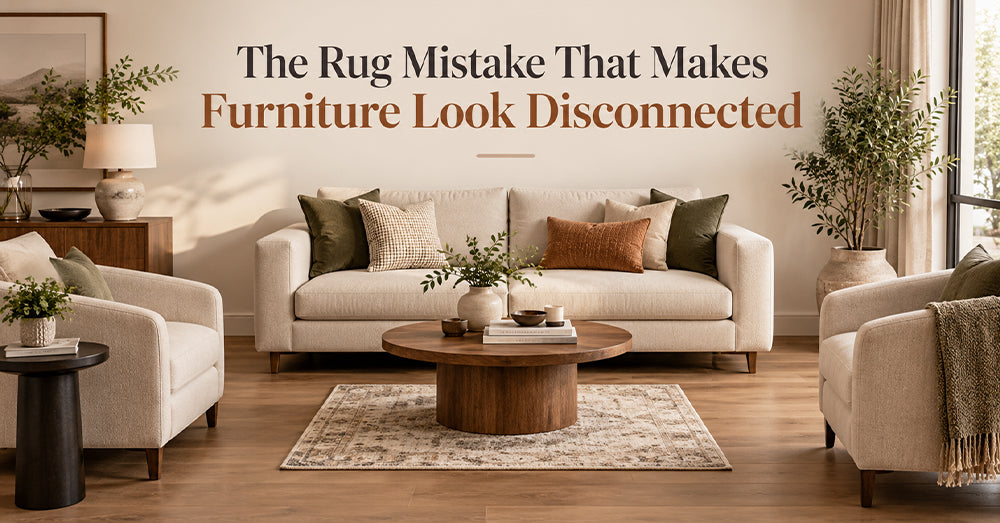
The rug mistake that makes furniture look disconnected is placing it without considering which furniture it needs to anchor. If the rug sits too far from the sofa, only reaches the coffee table, or fails to connect the main seating pieces, the furniture can look like it is floating in the room. The solution is to place the rug around the seating arrangement to create one clear, connected zone.
Why Does Furniture Look Disconnected From the Rug?
Think about how a living room is actually used.
You sit on the sofa, put your feet up, reach toward the coffee table, and perhaps turn toward an armchair when talking to someone. These pieces all support the same activity.
Your rug should visually reflect that relationship.
When the sofa is completely outside the rug, while the coffee table sits neatly in the middle of it, the eye sees two separate areas:
the furniture area and the rug area.
That is when the room can start to feel unfinished.
This is particularly noticeable in larger UK living rooms and open-plan spaces. Without walls to define the seating area, furniture can easily look scattered across the floor. A well-positioned rug gives those pieces a shared visual base.
Interior design guidance commonly recommends allowing at least part of the main seating furniture to sit on the rug, rather than leaving the rug isolated in the centre.
The Real Problem Is Often Not the Rug Itself

Before replacing your rug, consider how it’s placed.
A beautiful rug can still look wrong if it is:
- Too far away from the sofa
- Sitting only beneath the coffee table
- Not reaching the chairs
- Positioned at an awkward angle
- Centred on the room rather than the seating area
- Too small to visually connect the furniture
That is why simply buying a more expensive rug doesn’t necessarily solve the problem.
You need to think about the furniture-to-rug relationship first.
Should the Furniture Sit on the Rug?
No single rule works for every living room. The right arrangement depends on your room size, furniture layout and how much of the floor you want to show.
There are three common approaches.
1. Front Legs on the Rug
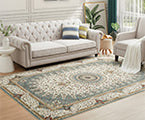
This is often the most practical arrangement for a typical living room. The front legs of the sofa and chairs sit on the rug while the back legs remain on the floor. The coffee table sits comfortably on the rug. This creates enough overlap for the furniture to feel connected without requiring a huge rug. This works particularly well when your sofa sits against a wall, and there is limited space behind it.
2. All Furniture on the Rug
If you have a larger living room, you may be able to place the entire seating arrangement on the rug. The sofa, chairs and coffee table all sit within the rug's boundaries. This creates a clearly defined seating zone and can work especially well when furniture is positioned away from the walls.
It is also useful in open-plan rooms where the rug needs to visually separate the living area from the rest of the space. People often use rugs this way to create distinct zones without adding physical partitions.
3. Furniture Completely Off the Rug
This can work, but it needs to look intentional.
A smaller rug under a coffee table can be used as an accent, especially in a compact room or when you want the flooring to remain the main feature. The problem comes when the rug is large enough to look like it should anchor the seating area, but none of the furniture actually touches it. That is when you get the classic floating rug effect.
The Coffee Table Is Not Enough
One of the most common mistakes is buying a rug that is just large enough for the coffee table. It looks fine when you first lay it down. The table is centred. The pattern is visible. The rug fits neatly into the available floor space. But then you look at the sofa. It is completely outside the rug. The chairs are outside too. Suddenly, the rug has become a little island in the middle of the room. If you want one connected seating area, the rug needs to relate to more than just the coffee table.
This does not mean every piece of furniture must sit completely on it. Even bringing the front legs of the main seating onto the rug can make a noticeable difference.
Centre the Rug Around the Furniture, Not Just the Room

This small detail can completely change the finished look. Many people naturally centre a rug in the middle of the room. But the middle of the room is not necessarily the middle of your seating arrangement. Imagine a long rectangular living room where the sofa, two chairs and coffee table occupy one side. If the rug is centred according to the four walls, it may end up too far away from the sofa.
Instead, look at the furniture as a group.
Ask:
Where does the seating area begin and end?
Your rug should help define that area.
This is especially useful in open-plan homes, where a rug can define the living room without physically dividing it from the dining or kitchen area.
How to Tell If Your Rug Is Too Small
A rug is probably too small for the furniture arrangement if:
- The sofa sits several centimetres away from the rug
- The chairs are completely outside it
- Only the coffee table fits comfortably on it
- The rug looks like an island surrounded by bare floor
- You can see a large gap between the rug and the main seating
- The furniture appears scattered even though the room is not particularly large
However, don’t automatically assume that a bigger rug is the answer.
Sometimes moving the existing rug is enough.
Try repositioning it closer to the sofa before you start shopping.
For detailed measurements and room-by-room guidance, you can also use RugsPile’s rug size guide instead of trying to apply one size to every living room.
A Simple Test Before You Buy a Bigger Rug

Here’s a useful trick if you are unsure whether your rug is actually too small.
Take some masking tape and mark the outline of the larger rug size you are considering directly on the floor.
Then put your furniture back where it normally sits.
Don’t judge it from above.
Stand in the doorway.
Look at it from the sofa.
Walk around the room.
Now ask yourself:
Does the taped area connect the sofa, chairs and coffee table more naturally?
If it does, you have useful evidence that the larger footprint is likely to work.
If it makes the room feel cramped or interferes with walking space, you may need a different size or arrangement.
This simple visual test is also recommended in current rug placement advice because it lets you judge the rug against your actual furniture before committing to a purchase.
Don’t Forget the Chairs
It is easy to concentrate on the sofa and forget about everything else.
But if you have two armchairs facing the sofa, they are part of the same seating arrangement.
Imagine this:
The sofa’s front legs are on the rug.
The coffee table is on the rug.
But both armchairs are several inches outside it.
The sofa and coffee table look connected, but the chairs look like separate furniture placed around them.
If possible, bring the chairs close enough for their front legs to sit on the rug too.
That small amount of overlap can make the whole seating arrangement read as one zone.
What If Your Living Room Is Small?
A small living room does not automatically need a tiny rug.
In fact, choosing a rug that is too small can make the furniture feel even more fragmented.
Instead of trying to fill every spare section of floor, think about what you want the rug to connect.
For example, in a compact lounge with a sofa and coffee table, you may want the rug to sit beneath both rather than choosing a tiny design that only fits under the table.
At the same time, leave enough clear flooring for doors to open properly and for people to move around comfortably.
A rug should define the seating area, not become an obstacle.
What About an Open-Plan Living Room?
Rugs can make a particularly noticeable difference here.
Without a rug, an open-plan space can become one large area where the sofa, dining table, television and other furniture all compete for attention.
A rug can create a visual boundary around the living room.
For example:
Rug + sofa + armchairs + coffee table = living zone
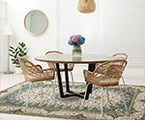
Dining table + dining chairs = dining zone
The areas remain open to each other, but each has a clearer purpose.
This is one reason rugs are useful beyond decoration. They can help organise a room without taking up additional wall or floor space.
Match the Rug to the Furniture Without Making Everything Identical
The rug does not have to match your sofa exactly.
In fact, an exact match can sometimes make the room feel overly coordinated.
Instead, look for a connection.
If your sofa is neutral, you might choose a patterned rug containing one of the accent colours already used in the room.
If your furniture is heavily patterned, a quieter rug may give the eye somewhere to rest.
If the room already contains several strong colours, a more restrained rug can help bring everything together without adding another competing element.
The goal is not to make every item identical.
It is to make the room feel like the pieces belong in the same conversation.
Think About Proportion, Not Just Size
A rug can technically be large enough and still look wrong.
Why?
Because its proportions may not suit the furniture.
For example, a long sofa paired with a very narrow rug can look unbalanced even if the rug reaches the furniture.
Likewise, a small seating arrangement can become overwhelmed by an enormous rug that leaves very little visible flooring.
Look at the overall shape of the arrangement.
A long rectangular seating area will generally feel more natural with a rug that follows its proportions. A smaller, more compact arrangement gives you more flexibility.
If you’re unsure, use the furniture footprint as your starting point rather than choosing a rug based purely on how much empty floor you have.
One RugsPile Example
If you are looking for a traditional patterned rug that can work with different furniture arrangements, the Burgundy & Beige Persian Traditional Washable Rug is available in several sizes.
Its burgundy, beige, and neutral tones work particularly well when the rug needs to bring different furniture colours together without requiring an exact match.
The important thing is still to choose the size based on your seating arrangement, rather than buying the product simply because it fits an empty section of floor.
7 Quick Ways to Fix a Disconnected Furniture Layout
Before replacing anything, try these adjustments.
1. Move the rug closer to the sofa
A surprisingly small shift can make a large visual difference.
2. Bring the chairs into the rug’s zone
If the chairs are part of the same seating arrangement, don’t leave them stranded around the edges.
3. Centre the rug with the seating
Forget the exact centre of the room and look at the furniture grouping instead.
4. Check the coffee table
It should feel naturally positioned within the seating arrangement, rather than sitting awkwardly on the rug’s edge.
5. Try a larger footprint with masking tape
See how the furniture would relate to a larger rug before spending money.
6. Look at the room from different angles
A layout that looks fine from the sofa may look completely different from the doorway.
7. Don’t rush to replace the furniture
If everything else works, the rug placement may be the easiest thing to change.
The Rug Should Bring the Room Together
A good rug does more than add colour or pattern to a room.
It gives the furniture somewhere to belong.
When the sofa, chairs and coffee table overlap naturally with the rug, the seating area feels deliberate rather than scattered. When the rug is isolated from the furniture, even a beautifully decorated room can feel slightly unfinished.
So before asking whether your sofa needs replacing or whether your living room needs more accessories, look down.
Is your rug actually connecting the furniture?
Sometimes the biggest improvement is not buying something new.
It is simply changing the relationship between the things you already have.
FAQs
Why does my furniture look disconnected?
Furniture can look disconnected when the rug does not visually link the main pieces. If the sofa, chairs and coffee table sit separately from the rug, the seating area can appear scattered rather than unified.
Should the front legs of a sofa be on the rug?
For many living rooms, placing the sofa’s front legs on the rug is a practical way to connect the sofa to the seating area without needing the entire sofa to fit on the rug. The exact arrangement depends on your room and furniture layout.
Can a rug be too small for a living room?
Yes. If a rug fits only under the coffee table and leaves the main seating outside it, it may not be large enough to anchor the furniture. However, a smaller rug can work when you use it deliberately as an accent.
Does a rug have to be centred in the room?
No. In many cases, it makes more sense to centre the rug around the furniture grouping. This is particularly useful in open-plan rooms where the rug defines the living area.
Should chairs be on the same rug as the sofa?
If the chairs form part of the same seating arrangement, connecting them to the same rug can help the furniture read as one group. Bringing their front legs onto the rug is one practical approach.
How do I know if I need a bigger rug?
Look at the relationship between the rug and the furniture. If the rug sits only beneath the coffee table and doesn’t reach the sofa or chairs, test a larger footprint with masking tape before buying.
Can I use a small rug in a small living room?
Yes. The important thing is how the rug relates to the furniture and how much space remains for comfortable movement. A small rug can work well when it deliberately defines a compact seating or accent area.
Final Thoughts
The easiest way to make a living room feel more connected isn’t necessarily to add more furniture, cushions, or accessories.
Start with the rug.
Look at where it sits, what furniture it touches and whether it actually defines the space you want it to define.
When the rug and furniture work together, the room feels naturally pulled together.
When they don’t, even beautiful pieces can look as though they were simply placed in the same room.
Your rug does not just belong on the floor. It should help the furniture feel like it belongs together.